
Did you ever look in a mirror after a business meeting and discover a glaringly obvious piece of food in your teeth? Or a coffee stain where you hadn’t seen it before? You know that embarrassing feeling you get at that moment? That’s how you look when you misuse the language.
Yes, I know, many people, even some well-educated people, seem to think grammar and spelling are as obsolete as a VCR. And some rules are easily broken. I’ll start a sentence with “But” sometimes and I sometimes use periods for phrases rather than complete sentences. But I know it when I do it. When these are mistakes, they make you look bad.
- awesome
- Awe is supposed to be “an overwhelming feeling of wonder or admiration,” or “a feeling of profound respect.” Awesome doesn’t mean good, or cool, or nice, interesting, or convenient. The enormous power of nature might be awesome, a dish in a restaurant isn’t. A view, a storm, a cliff, a mountain, a waterfall might be awesome, a good cup of coffee isn’t. I suspect this started in the 1970’s when Howard Cosell (a sportscaster) used that word way too often to describe a good football play or a talented football player on Monday Night Football.
- I just saw a business plan rating sheet that included “awesome” as one of the possible ratings of certain factors in a plan. No offense to anybody, but no business plan has ever been awesome about anything. And I like business plans.
- incentivizing or incenting
- Say motivating instead. It’s a real word, it already exists, and has a perfectly obvious meaning. Incentives are supposed to motivate employees, not incentivize them, and not incent them.
- hopefully
- If you mean I hope, say that instead. When you say “hopefully our team wins” you said our team wins and is full of hope as it does. Did you mean “I hope our team wins?”
- Hopefully is like quickly or softly; it gives more detail about how something is done. She runs quickly. He speaks softly. Many people voted hopefully.
- unique
- Something unique is one of a kind, like no other. It’s unique or it isn’t; there are no degrees of unique. More unique or less unique makes no sense.
- criteria
- The word criteria is plural. The singular is criterion. This is a lot like phenomena (plural) and phenomenon (singular). I think the world has given up on data, which is technically the plural of datum. I have.
 And while we’re on the subject of bad English, here are some other common word and grammar mistakes, some in business and some not, that didn’t make my top 5 list:
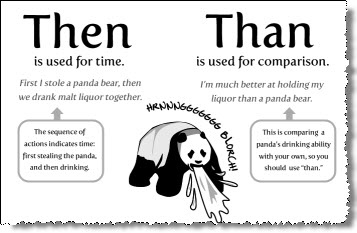
- then and than
- One of my pet peeves: Then is sequential, than is comparison. You have more than I do. First we generate options, then we make a decision. And the illustration here is from TheOatmeal.com, by the way, a nice post there listing 10 words you probably misspell.
- break even
- The phrase is poorly defined. It means different things to different people. The most common financial meaning is about the break-even point, which is when revenue for some time frame is equal to costs and expenses. There is a specific financial calculation involved. But many people use “break even” to mean something like payback period, a point in which return from an investment equals the original investment.
- turn over
- Another poorly defined term, used in a lot of contexts. It often means sales, but sometimes refers to the opposite of employee retention, people leaving a company, and also has some specialized meanings related to business ratios for inventory.
- those annoying apostrophes
- Some people think you can’t have more than one of anything without an apostrophe. The apostrophe shows contraction (don’t) or possession (Tim’s), not plurality. It isn’t cars’ or books’ or table’s just because you have more than one. Cars’ would indicate possession, something that belongs to more than one car, like the cars’ exhaust. Books’ would indicate possession, something that belongs to more than one book, like the books’ covers. And table’s would be something that belongs to a table, like the table’s legs.
- migraine
- A migraine is not just a bad headache, and a bad headache is usually not a migraine. A migraine is a special kind of headache, much more common in women than men, usually affects only one half of the head, and often involves dizziness, nausea, and sensitivity to light.


 By
By 


Comments
If “incentivize” is not yet a word, it ought to be. The concept people are often trying to convey when they use that word is not the same as “motivate.” I’m not aware of an existing word that conveys the legitimate idea people want to express.
@Ihatemaking thanks for that addition. I admit, you have a good rationale there. I see the logic, but I’d still rather motivate people, and be motivated, than incentivize and be incentivized. Sounds very much like business speak to me. But usage wins all.
Yet another fine example of grammar being misused is people using the phrase “different than” when it should be phrased as “different from.” Also, the misuse of alumni versus alumnus.
There are many mistakes in grammar that annoy me. A split infinitive affects me the same way as nails on a chalkboard. Also, it seems as though few people understand that the word “none” is a contraction for “not one.” Therefore, it is incorrect to say “none are.” To be grammatically correct, you would say “none is” because you are agreeing the noun “one” with the verb “is.” I was curious to note that no one commented upon Admiral’s mistake of writing “irregardless.” Not only is it a substandard use of “regardless,” but is redundant as well.
I could care less about how good our grammar is, irregardless you’ve got to take preventative measures to make sure you connect with your readership.
Have to disagree with a few of these. Hopefully: though the first definition is “in a hopeful manner,” the second definition is “it is hoped, I hope, we hope.” To use it as such is correct. Awesome: also means “terrific” or “excellent.” Does not always indicate that something literally inspires awe. Incentivizing/incenting: both real words (found in dictionaries) with clear meanings.
You forgot the “s” in exhausts. It should be “cars’ exhausts” since you’re referring to more than one car’s exhaust.
David, I don’t think so, at least not necessarily. Would you say “exhausts from the cars?” Would you say “the smokes from the chimneys?” I think exhaust is a substance that is singular, produced by multiple cars. If, however, you wanted to think of the exhaust as a singular system, as in an exhaust pipe — and I’ve seen it used that way — then you’d be right on that one.
Grammar is fun.
Tim
[…] Use a spellchecker at least, but recognize as you do that spellcheckers don’t catch a lot of glaringly bad errors. Using “there” for “their,” for example, or the very common confusion of apostrophes and […]
… and how many people use the term ‘Return on Investment’ without having a clue what it really means or how to calculate it!
I would like to read a guide line on the use of commas.
Deanna, I just did a quick search in Google for “how to use commas.” It seems to turn up several alternatives, even some videos.
https://www.google.com/search?q=how+to+use+commas
[…] Use a spellchecker at least, but recognize as you do that spellcheckers don’t catch a lot of glaringly bad errors. Using “there” for “their,” for example, or the very common confusion of apostrophes and […]
[…] Use a spellchecker at least, but recognize as you do that spellcheckers don’t catch a lot of glaringly bad errors. Using “there” for “their,” for example, or the very common confusion of apostrophes and […]
Speaking of tranitive (mis) usage – How about “grow” a business, “grow” the economy? I remember when I first heard this, and thought – oh great, some reporter or speech writer is relying too much on their thesaurus. But it is now commonplace, and I am not amused!
You forgot “impact [on]” used transitively. You can HAVE an impact on something, but only wisdom teeth can be impacted.
This post made me laugh. “Awesome” is a word that is used by my generation in a way that is the same as “cool” was a decade ago. “Incentivizing” is a word that most spell-checkers hate, but it is a real word that is used in economics and sociology.
Mine is “Alls” as in Alls i want versus All I want.
I am pleased to see someone else teaching these simple everyday errors in American language. Would you please post the apostrophe paragraph on as many sites as you can?
My favourite misused word is leverage when used as a verb (which it isn’t). If you say “we can leverage that” what you really mean is “we can lever that”.
Oh contrar – leverage is also a verb. Check out the dictionary. Lever, on the other hand, is a noun.
Thanks Tommy, interesting case. I agree completely with Richard on his example, but Merriam Webster makes you also right…
http://www.merriam-webster.com/dictionary/leverage
… because it starts with the noun but acknowledges the verb, as you suggest, as an additional usage. It says the first usage of that was in 1957, so I think it’s one of those cases in which the language gradually changes.
And lever is of course also a noun, but also a verb used correctly in Richard’s example …
http://www.merriam-webster.com/dictionary/lever
… so you’re right, but he’s not wrong, and I’m adding my reply because I still like the shorter form, (“we can lever that”) better. And by the way…
http://www.merriam-webster.com/dictionary/au%20contraire
Another pet peeve: NOWADAYS, my students love this word, when saying today, now, presently. What do you rate this word, Tim?
PS. congrats on your website-blog, I am using it more and more in my Entrepreneurship classes.
One of my peeves is when people say “very unique”. As you said, unique is a singularity. You can’t narrow it down any further.
I don’t understand your objection to turn over or break even. Maybe you see them misused more in business plan competitions. I rarely see them used at all and when I do they are used correctly.
I have to add this as a comment. I just received an email from Sam Richter, a friend, speaker, and coach. The email subject line was “Awesome blog post today.” The text was:
Notice, by the way, that Sam adds another common one with affective writing (should be effective). Nice touch. Thanks Sam.
Tim